Table of Contents
- Introduction
- Direct Answer
- Quick Comparison Table
- Deep Meanings & Definitions
- Historical Origin & Etymology
- Pronunciation Guide
- The Technical Differences
- Correct Spelling & Common Typos
- Mnemonic Devices (Memory Tricks)
- Regional Variations (US vs. UK English)
- Singular and Plural Forms
- Grammar Rules & Parts of Speech
- Synonyms and Related Terms
- Formal vs. Informal Usage
- Illustrative Examples
- Practice Section (15 MCQs)
- Frequently Asked Questions (FAQs)
- Conclusion
what does vod mean | Everything You Need to Know About This Internet Acronym
Introduction
I often come across readers confused by modern internet abbreviations, and one of the most frequently searched phrases is “wwhat does vod mean”. The extra “w” itself shows how easily people mistype when searching for answers online.
In today’s digital world, acronyms like VOD appear everywhere—from streaming platforms to gaming communities. Yet many people still don’t fully understand what it stands for or how it is used.
I want to break this down in a clear, academic, but simple way so you never feel confused again.
Understanding VOD meaning is important because it appears in entertainment, education, business, and even social media content.
By the end of this guide, you will not only know what VOD means but also how it works in real-life digital communication.
Let’s decode it step by step.
Direct Answer
VOD stands for “Video on Demand.” It refers to a digital media system that allows users to watch video content whenever they want, rather than at a scheduled broadcast time. It is widely used in streaming services like Netflix, YouTube playback, and online learning platforms.
Quick Comparison Table
| Aspect | VOD (Video on Demand) |
| Full Form | Video on Demand |
| Core Meaning | Watch videos anytime |
| Usage Context | Streaming, entertainment, education |
| Access Type | User-controlled playback |
| Example Platforms | Netflix, Amazon Prime, YouTube |
Deep Meanings & Definitions
The term VOD (Video on Demand) is a digital communication concept that changed how humans consume media.
Core definition:
VOD is a system that allows users to select, stream, and watch video content at their convenience, without following a fixed broadcast schedule.
Key characteristics:
- On-demand access (no timing restrictions)
- Digital streaming or download
- User-controlled playback
- Content libraries instead of live schedules
Types of VOD:
- Subscription VOD (SVOD) – Netflix, Disney+
- Transactional VOD (TVOD) – Rent or buy movies
- Advertising VOD (AVOD) – Free platforms with ads like YouTube
In simple linguistic terms, VOD is a compound acronym noun representing a technological service model.
Historical Origin & Etymology
Unlike traditional words, VOD is a modern technological acronym, not derived from Latin or French roots as classical vocabulary is.
Breakdown of the term:
- Video → From Latin videre, meaning “to see”
- On → Old English origin, preposition indicating connection
- Demand → From Latin demandare, meaning “to request or ask for”
Evolution:
- 1980s–1990s: Concept of pay-per-view TV emerges
- Early 2000s: Internet streaming begins shaping digital media
- 2010s onward: VOD becomes mainstream with Netflix and YouTube expansion
So linguistically, VOD is a modern hybrid acronym formed from older linguistic roots combined into a digital-era phrase.
Pronunciation Guide
- VOD → /viː.oʊ.diː/ or simply “vod”
- Rhymes with: “rod,” “nod,” or “cod”
Spoken forms:
- “Vee-oh-dee” (formal tech speech)
- “Vod” (casual conversation)
The Technical Differences
People often confuse VOD with other streaming terms. Let’s clarify:
VOD vs Live Streaming
- VOD → Pre-recorded, watch anytime
- Live Streaming → Real-time broadcast
VOD vs Broadcast TV
- VOD → User chooses content and timing
- TV Broadcast → Fixed schedule
Why confusion happens:
- Both involve video content
- Streaming platforms mix live + on-demand features
- Users often don’t distinguish backend systems
From a linguistic standpoint, VOD is a functional semantic term, meaning its definition depends on usage context.
Correct Spelling & Common Typos
Common mistakes:
- wwhat does vod mean
- what is vdo mean
- vod meaning in vedio
- what does v.o.d stand for
Why these errors happen:
- Fast typing on mobile keyboards
- Autocorrect interference
- Lack of familiarity with acronym structure
Correct form is always: VOD
Mnemonic Devices (Memory Tricks)
To remember VOD easily:
“VOD = View On Demand”
Or:
“Video On Demand = Watch Only When Desired”
Simple memory hook:
- V = Video
- O = On
- D = Demand
Regional Variations (US vs. UK English)
Unlike spelling differences in traditional English, VOD remains globally consistent.
However usage varies:
- US: Common in streaming and tech industries
- UK: Used more in broadcasting and academic media studies
- Global: Standardized across platforms like Netflix, YouTube, Amazon
No spelling variation exists because it is an acronym.
Singular and Plural Forms
Singular:
- VOD refers to a system or service
Plural:
- VODs = multiple video-on-demand services or pieces of content
Example:
- “Streaming platforms offer multiple VODs.”
Possessive:
- “VOD’s popularity is increasing worldwide.”
Grammar Rules & Parts of Speech
VOD functions as:
- Noun (primary usage)
- “VOD is growing fast.”
It can also act as:
- Attributive noun (modifier)
- “VOD platform”
- “VOD service”
Linguistic classification:
- Acronym-based lexical item
- Tech-specific noun phrase
Synonyms and Related Terms
Synonyms:
- On-demand video
- Streaming content
- Digital playback media
- Instant video access
Antonyms:
- Live broadcast
- Scheduled TV
- Real-time transmission
Related concepts:
- OTT (Over-The-Top media)
- IPTV (Internet Protocol TV)
- Streaming services
Formal vs. Informal Usage
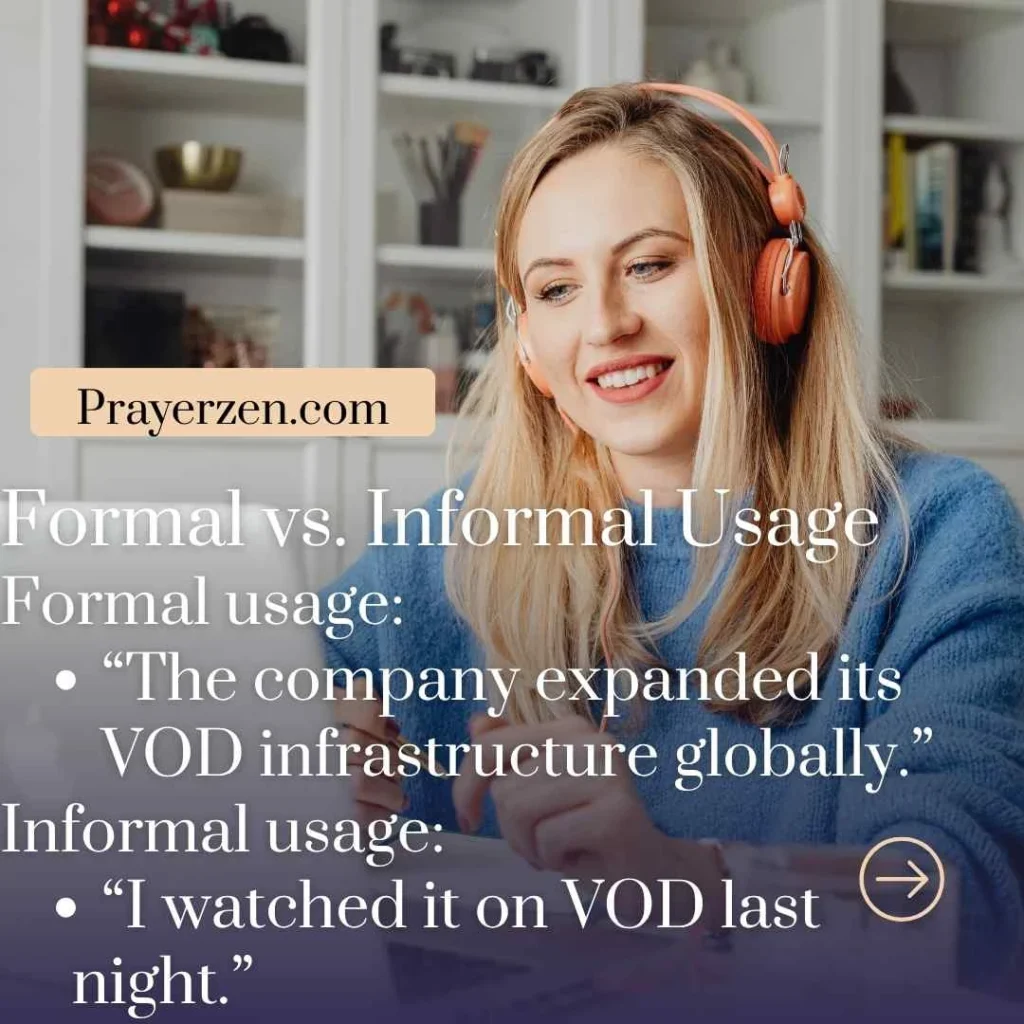
Formal usage:
- “The company expanded its VOD infrastructure globally.”
Informal usage:
- “I watched it on VOD last night.”
Where it appears:
- Business reports
- Tech documentation
- Entertainment discussions
- Social media chats
Illustrative Examples
- Netflix is a popular VOD platform.
- I prefer watching movies on VOD.
- The VOD service crashed during peak hours.
- Students use VOD lectures for studying.
- This app offers free VOD content.
- VOD changed how people consume media.
- The movie is available on VOD now.
- He subscribed to a premium VOD service.
- VOD allows flexible viewing schedules.
- Many gamers stream VOD replays.
- The website provides educational VOD content.
- VOD systems require strong internet connections.
Practice Section (15 MCQs)
1. What does VOD stand for?
A) Video on Demand
B) View online data
C) Visual on Display
D) Video of Device
2. VOD allows users to:
A) Watch live only
B) Watch anytime
C) Download games
D) Send messages
3. VOD is mainly used in:
A) Agriculture
B) Streaming media
C) Manufacturing
D) Transportation
4. Which is a VOD platform?
A) Netflix
B) Facebook only
C) Gmail
D) Google Maps
5. VOD is opposite of:
A) Streaming
B) Live broadcast
C) Internet
D) Download
6. “Demand” in VOD means:
A) Request
B) Speed
C) Video
D) Sound
7. VOD is a:
A) Verb
B) Noun
C) Adjective
D) Preposition
8. VOD content is:
A) Scheduled
B) Random
C) On-demand
D) Offline only
9. VOD is mostly:
A) Analog
B) Digital
C) Physical
D) Mechanical
10. Another term related to VOD is:
A) OTT
B) HTML
C) CPU
D) GPS
11. VOD originated from:
A) Ancient Latin phrase
B) Modern digital media
C) Greek mythology
D) Handwriting systems
12. Users watch VOD:
A) Only in cinemas
B) At fixed time
C) At any time
D) Only offline
13. VOD is part of:
A) Social media only
B) Streaming technology
C) Banking system
D) Education only
14. Plural of VOD is:
A) VODS
B) VODs
C) Voded
D) Voding
15. VOD improves:
A) Flexibility
B) Weather
C) Gravity
D) Hardware
Answer Key:
1-A, 2-B, 3-B, 4-A, 5-B, 6-A, 7-B, 8-C, 9-B, 10-A, 11-B, 12-C, 13-B, 14-B, 15-A
Frequently Asked Questions (FAQs)
1. What is VOD in simple words?
VOD means watching videos whenever you want online.
2. Is YouTube a VOD platform?
Yes, most YouTube videos are considered VOD content.
3. Is VOD free or paid?
It can be both—some platforms are free, others require subscriptions.
4. What is the difference between VOD and live TV?
VOD is on-demand, while live TV follows a schedule.
5. Why is VOD popular?
Because it gives users control over what and when they watch.
Conclusion
The meaning of “what does vod mean” ultimately leads us to a simple but powerful concept: Video on Demand.
It represents a shift in how humans consume digital media.
Instead of waiting for scheduled programming, users now control their viewing experience.
From streaming platforms to education systems, VOD is everywhere.
Understanding it helps you navigate modern digital culture more effectively.
As technology evolves, VOD will continue shaping the future of entertainment and learning.

Olivia Brooks
Hi, I’m Olivia Brooks, a passionate writer and believer in the power of words and prayers. Ever since I can remember, I’ve found comfort and inspiration in sharing thoughts that uplift the soul. Writing, for me, is not just a craft—it’s a way to connect hearts and bring hope to those who need it most. I love exploring the delicate balance between faith, life challenges, and finding peace in everyday moments. Through my stories, I hope to remind everyone that even in the darkest times, a little prayer can light the way. When I’m not writing, you’ll find me enjoying quiet mornings with a cup of tea and my journal.
Books by Olivia Brooks:
-
Whispers of the Soul
-
Light in the Shadows