

Table of Contents
- Introduction
- Direct Answer
- Quick Comparison Table
- Deep Meanings & Definitions
- Historical Origin & Etymology
- Pronunciation Guide
- The Technical Differences
- Correct Spelling & Common Typos
- Mnemonic Devices
- Regional Variations
- Singular and Plural Forms
- Grammar Rules
- Synonyms and Antonyms
- Formal vs. Informal Usage
- Illustrative Examples
- Practice Section (15 MCQs)
- Frequently Asked Questions
- Conclusion
Introduction
I have often encountered believers and seekers alike who are deeply moved yet uncertain about the name “Jehovah Jireh.” What does this ancient Hebrew phrase truly mean, and why does it resonate so powerfully across millennia? This question is not merely academic; it addresses a profound human need for assurance and divine provision. In this guide, I will explore the rich layers of meaning behind this name, from its biblical roots to its enduring spiritual significance.
Direct Answer
“Jehovah Jireh” is a Hebrew name for God meaning “The Lord Will Provide.” It originates from Genesis 22:14, where Abraham names the place of Isaac’s near-sacrifice after God provides a ram as a substitute offering.
Quick Comparison Table
| Feature | Jehovah | Jireh |
| Meaning | The LORD (covenant name of God) | Will provide / will see to it |
| Origin | Hebrew (YHWH / Yahweh) | Hebrew (ra’ah – to see) |
| Combined Meaning | The LORD Will Provide | The LORD Will See To It |
| Biblical Reference | Genesis 22:14 | Genesis 22:14 |
Deep Meanings & Definitions
Jehovah Jireh is a compound name of God that appears once in the Bible, in Genesis 22:14. It combines God’s covenant name with a verb that carries profound meaning.
- Jehovah: The anglicized form of YHWH, God’s personal, covenant name.
- Jireh: Derived from the Hebrew verb ra’ah, meaning “to see” or “to perceive.” In this context, it carries the sense of “to foresee and provide.”
The phrase “The Lord Will Provide” is the standard translation, but it also implies “The Lord will see to it” or “The Lord who sees.”
Historical Origin & Etymology
Biblical Context:
The name is rooted in Genesis 22, often called the “Binding of Isaac.” God tests Abraham’s faith by commanding him to sacrifice his beloved son, Isaac.
- Abraham obeys, preparing to offer Isaac on Mount Moriah.
- At the crucial moment, an angel stops him.
- Abraham sees a ram caught in a thicket and sacrifices it instead of Isaac.
Etymology:
- Jehovah: From the Tetragrammaton YHWH (יהוה), vocalized in English as “Jehovah.”
- Jireh: From the Hebrew verb ra’ah (רָאָה), meaning “to see.” In Hebrew thought, “to see” is often linked to “to provide”—one sees a need and acts to meet it.
- Evolution: The name appears as “Jehovah-jireh” in the King James Version, reflecting 17th-century English pronunciation.
Pronunciation Guide
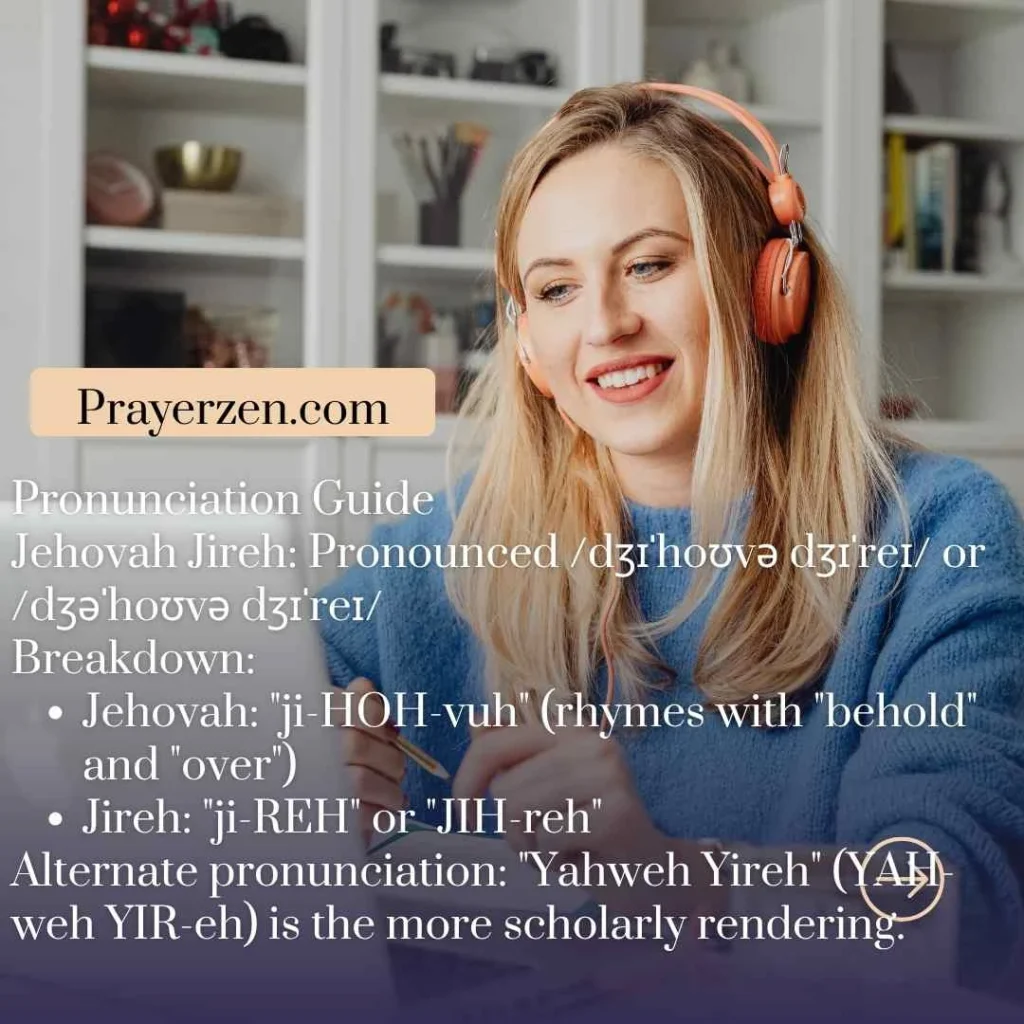
Jehovah Jireh: Pronounced /dʒɪˈhoʊvə dʒɪˈreɪ/ or /dʒəˈhoʊvə dʒɪˈreɪ/
Breakdown:
- Jehovah: “ji-HOH-vuh” (rhymes with “behold” and “over”)
- Jireh: “ji-REH” or “JIH-reh”
Alternate pronunciation: “Yahweh Yireh” (YAH-weh YIR-eh) is the more scholarly rendering.
The Technical Differences
The confusion around “Jehovah Jireh” often involves spelling and pronunciation variations, not theological meaning.
Variations:
- Jehovah-jireh (KJV style with hyphen)
- Jehovah Jireh (modern style, no hyphen)
- Yahweh Yireh (scholarly transliteration)
- Jehovahjireh (one word, older style)
Key Distinction:
- “Jireh” is not a separate name of God but part of a compound name.
- The verb ra’ah can mean “to see” and “to provide,” giving the name dual significance.
Correct Spelling & Common Typos
Correct Spelling:
- Jehovah Jireh (modern standard)
- Jehovah-jireh (traditional with hyphen)
- Yahweh Yireh (scholarly transliteration)
Common Typos:
- Jehovah Jireh (confusing ‘i’ and ‘e’)
- Jehovah Jirah
- Jehova Jireh (missing the ‘h’)
- Jehovah Jire (dropping the final ‘h’)
- Jahovah Jireh (confusing ‘e’ and ‘a’)
Mnemonic Devices

- Jireh = Just In time, Really Equips His children. God provides when we need it most.
- “Jehovah Jireh” – Remember: Jehovah Just Provides. The two “J’s” remind you of the full name.
- Visual: Picture a mountain with a ram caught in a thicket—”The Mountain of the Lord” where provision appears.
Regional Variations
No Significant Regional Variation:
“Jehovah Jireh” is a transliteration of Hebrew, so spelling is consistent across English varieties.
- American English: Jehovah Jireh
- British English: Jehovah Jireh
- Canadian English: Jehovah Jireh
- Australian English: Jehovah Jireh
The only variation is stylistic: hyphen vs. no hyphen, and the use of “Yahweh” in academic contexts.
Singular and Plural Forms
As a Proper Name:
“Jehovah Jireh” is a proper name and does not have plural forms.
- Always singular. Example: “We trust in Jehovah Jireh.”
Possessive Forms:
- “Jehovah Jireh’s provision” (referring to God’s action)
Note: The name refers to one God (Jehovah) acting as Provider (Jireh).
Grammar Rules

Part of Speech: Proper Noun (a name for God)
Grammar Functions:
- Noun (Subject): “Jehovah Jireh provides for His people.”
- Noun (Object): “We call upon Jehovah Jireh.”
Usage Rules:
- Capitalized as a proper name.
- “Jehovah” is the name of God; “Jireh” specifies His character as Provider.
- Often used in worship and prayer as a title of God.
Synonyms and Antonyms
Synonyms (Related Names of God):
- El Shaddai – God Almighty (emphasizing power)
- Jehovah Nissi – The Lord is my Banner
- Jehovah Rapha – The Lord who Heals
- Jehovah Shalom – The Lord is Peace
- Jehovah Rohi – The Lord is my Shepherd
Theological Equivalents:
- “The God who sees and provides”
- “The Provider”
- “The God of Provision”
Antonyms (Conceptual opposites):
None directly, but contrast with:
- Lack / Scarcity
- Dependence on self
Formal vs. Informal Usage
Formal Contexts (Academic, Theological):
Use the scholarly transliteration “Yahweh Yireh” and cite Genesis 22:14.
- Example: “The name Yahweh Yireh signifies God’s active foresight and provision.”
Informal Contexts (Sermons, Worship, Devotion):
“Jehovah Jireh” is widely used and deeply meaningful.
- Example: “God is my Jehovah Jireh—He will supply all my needs.”
Creative Writing/Poetry:
The name evokes imagery of trust and divine intervention.
- Example: “In my wilderness, I found Jehovah Jireh waiting.”
Illustrative Examples
- Abraham named the place “Jehovah Jireh” after God provided the ram.
- In times of need, I remember that Jehovah Jireh is my provider.
- The story of Jehovah Jireh foreshadows God’s ultimate provision in Christ.
- “On the mountain of the Lord, it shall be provided” echoes the promise of Jehovah Jireh.
- We worship Jehovah Jireh, the God who sees and supplies.
- When resources are scarce, trust in Jehovah Jireh.
- The name Jehovah Jireh reminds us that God is never late.
- His name Jehovah Jireh means He knows our needs before we ask.
- In the Old Testament, Jehovah Jireh was revealed at Moriah.
- Paul’s words, “My God shall supply all your needs,” echo Jehovah Jireh.
- The ram caught in the thicket was a symbol of Jehovah Jireh.
- We pray to Jehovah Jireh, trusting Him for daily bread.
Practice Section (15 MCQs)
- What does Jehovah Jireh mean?
- a) The Lord is my Shepherd
- b) The Lord Will Provide
- c) The Lord is Peace
- d) The Lord Heals
- Where in the Bible does Jehovah Jireh appear?
- a) Exodus 3:14
- b) Genesis 22:14
- c) Psalm 23:1
- d) John 3:16
- “Jireh” comes from the Hebrew verb meaning:
- a) To see
- b) To provide
- c) Both a and b
- d) To bless
- What was Abraham about to sacrifice when God provided a substitute?
- a) A lamb
- b) Isaac
- c) Ishmael
- d) A bull
- What animal did Abraham sacrifice instead of his son?
- a) A lamb
- b) A ram
- c) A goat
- d) A dove
- The mountain where Abraham offered Isaac is called:
- a) Sinai
- b) Moriah
- c) Zion
- d) Carmel
- “Jehovah” is the anglicized form of:
- a) Elohim
- b) YHWH
- c) Adonai
- d) El Shaddai
- Which event does Jehovah Jireh foreshadow?
- a) The Exodus
- b) The giving of the Law
- c) The sacrifice of Christ
- d) The building of the Temple
- In the King James Version, the name is spelled:
- a) Jehovah-jireh
- b) Jehovah Jireh
- c) Yahweh Yireh
- d) YHWH Yireh
- How many times does “Jehovah Jireh” appear in the Bible?
- a) Once
- b) Twice
- c) Three times
- d) Seven times
- The phrase “In the mount of the Lord it shall be seen” refers to:
- a) God’s power
- b) God’s provision
- c) God’s judgment
- d) God’s glory
- “Jehovah Jireh” is primarily a:
- a) Verb
- b) Proper name
- c) Common noun
- d) Adverb
- The scholarly transliteration of Jehovah Jireh is:
- a) El Shaddai
- b) Yahweh Yireh
- c) Adonai Elohim
- d) Jehovah Nissi
- The name emphasizes:
- a) God’s power
- b) God’s provision and foresight
- c) God’s judgment
- d) God’s holiness
- Which New Testament verse echoes Jehovah Jireh’s promise?
- a) Matthew 6:33
- b) Romans 8:32
- c) Both a and b
- d) Neither
Answer Key:
- b
- b
- c
- b
- b
- b
- b
- c
- a
- a
- b
- b
- b
- b
- c
Frequently Asked Questions
Q1: What does Jehovah Jireh mean?
It means “The Lord Will Provide” or “The Lord will see to it,” combining God’s covenant name with the Hebrew verb ra’ah (to see/provide).
Q2: Where in the Bible is Jehovah Jireh found?
The name appears only once in Genesis 22:14, when Abraham names the mountain where God provided a ram instead of Isaac.
Q3: Is “Jireh” a separate name of God?
No, “Jireh” is part of the compound name “Jehovah Jireh.” It is not used independently as a divine name in Scripture.
Q4: How do you pronounce Jehovah Jireh?
“ji-HOH-vuh ji-REH” (or “YAH-weh YIR-eh” in the scholarly transliteration).
Q5: What is the significance of Jehovah Jireh?
The name reveals God’s nature as the Provider who foresees and supplies needs, ultimately fulfilled in Jesus Christ—the Lamb of God provided for our salvation.
Conclusion
I hope this comprehensive guide has illuminated the profound meaning of Jehovah Jireh—”The Lord Will Provide.” More than just a name, it is a declaration of God’s character, rooted in Abraham’s faithful obedience and culminating in the ultimate provision of Christ. This name assures us that God sees our needs and acts to meet them. Whether facing scarcity or uncertainty, we can trust in Jehovah Jireh, the God who provides, for every temporal and spiritual need. Remember, on the mountain of the Lord, it shall be provided!

Julian Gray
Hello, I’m Julian Gray, a writer and seeker of spiritual wisdom. My journey began with a simple curiosity about the power of prayers and how they shape our daily lives. Over the years, I’ve explored different traditions, meditations, and practices, always looking for ways to bring peace and clarity to the heart. Writing allows me to share these insights with readers who, like me, are searching for hope, inspiration, and connection. I believe that even small acts of prayer can transform our world in meaningful ways. Through my words, I aim to encourage reflection, gratitude, and a deeper understanding of life.
Books:
-
Whispers of the Soul
-
Paths to Peace