

Table of Contents
- Introduction
- Direct Answer: What Does Solvent Mean?
- Quick Comparison Table
- Deep Meanings & Definitions
- Historical Origin & Etymology
- Pronunciation Guide
- The Technical Differences Behind the Meaning
- Correct Usage & Common Misconceptions
- Mnemonic Devices (Memory Tricks)
- Regional Variations (US vs UK English Usage)
- Singular and Plural Forms
- Grammar Rules & Parts of Speech
- Synonyms and Antonyms
- Formal vs Informal Usage
- Illustrative Examples
- Practice Section (15 MCQs)
- Frequently Asked Questions (FAQs)
- Conclusion
Introduction

I often notice that the word “solvent” confuses readers because it appears in two completely different worlds chemistry and finance. Many people search what does solvent mean expecting a simple answer, but the truth is layered and context-dependent.
In chemistry, it relates to liquids that dissolve substances.
In finance, it describes whether a person or company can pay debts.
These dual meanings make it an interesting linguistic case study.
Understanding it properly helps you avoid confusion in academic, professional, and everyday contexts.
In this article, I will break down every dimension of the word using both scientific clarity and linguistic insight so you never misinterpret it again.
Direct Answer: What Does Solvent Mean?
A solvent is a substance usually a liquid that dissolves a solute to form a solution in chemistry. In finance, solvent describes an individual or organization that has enough assets to pay its debts. The meaning depends on context but always relates to the idea of “ability to dissolve or cover obligations.”
Quick Comparison Table
| Aspect | Chemical Meaning | Financial Meaning |
| Definition | Substance that dissolves others | Ability to pay debts |
| Usage Field | Chemistry | Economics/Finance |
| Example | Water as a solvent | A solvent company |
| Core Idea | Dissolving ability | Financial stability |
Deep Meanings & Definitions
Chemical definition
In chemistry, a solvent is:
- A liquid substance that dissolves a solute
- The major component in a solution
- Common examples: water, ethanol, acetone
Example:
- Salt + water → saltwater solution
Here, water is the solvent
Financial definition
In finance, solvent means:
- Having sufficient assets to cover liabilities
- Being financially stable
- Opposite of bankruptcy or insolvency
Example:
- “The company remains solvent after repaying its loans.”
Historical Origin & Etymology
The word solvent comes from Latin:
- Latin root: solvĕre = “to loosen, dissolve, or release”
- Past participle: solvens = “dissolving”
Evolution path:
- Latin → Old French → Middle English → Modern English
Originally, it strictly referred to dissolving substances.
Later, financial usage developed metaphorically:
- “Dissolving debts” → ability to pay obligations
So linguistically, both meanings share a core idea: breaking down or resolving something.
Pronunciation Guide

- Solvent → /ˈsɒl.vənt/ (British)
- Solvent → /ˈsɑːl.vənt/ (American)
Easy pronunciation trick:
- Sounds like: “SOL-vent”
- Rhymes with: “moment” (softly similar ending)
Break it down:
- SOL = like “solve”
- VENT = like “event”
The Technical Differences Behind the Meaning
The confusion around what does solvent mean comes from semantic expansion.
Why two meanings exist:
1. Chemical logic
- Solvent “dissolves” substances
- Focus: physical transformation
2. Financial metaphor
- Debt is “dissolved” through payment
- Focus: economic stability
Linguistic explanation:
This is called semantic extension, where:
- A word expands from physical meaning → abstract meaning
So:
- Chemistry = literal dissolving
- Finance = metaphorical dissolving of debt
Correct Usage & Common Misconceptions
Common mistakes:
- Thinking solvent only relates to chemistry
- Confusing “solvent” with “solution”
- Using it incorrectly in financial contexts
- Assuming it means “strong” or “rich” only
Why confusion happens:
- Same spelling in two fields
- School teaching often separates contexts
- Lack of etymological awareness
Mnemonic Devices (Memory Tricks)
To remember both meanings:
“A solvent SOLVES things—chemically or financially.”
Or:
“If it dissolves matter or debt, it’s solvent.”
Simple memory anchor:
- SOL = Solve = Dissolve problems
Regional Variations (US vs UK English Usage)
Unlike spelling differences, meaning is consistent globally:
United States:
- Common in finance and chemistry education
United Kingdom:
- Same meanings, slightly more formal usage in finance writing
Global scientific usage:
- Chemical meaning universally standardized
No major regional differences in definition.
Singular and Plural Forms
Forms:
- Singular: solvent
- Plural: solvents
Example:
- “Different solvents are used in laboratories.”
Possessive:
- “The solvent’s properties determine reaction speed.”
Grammar Rules & Parts of Speech
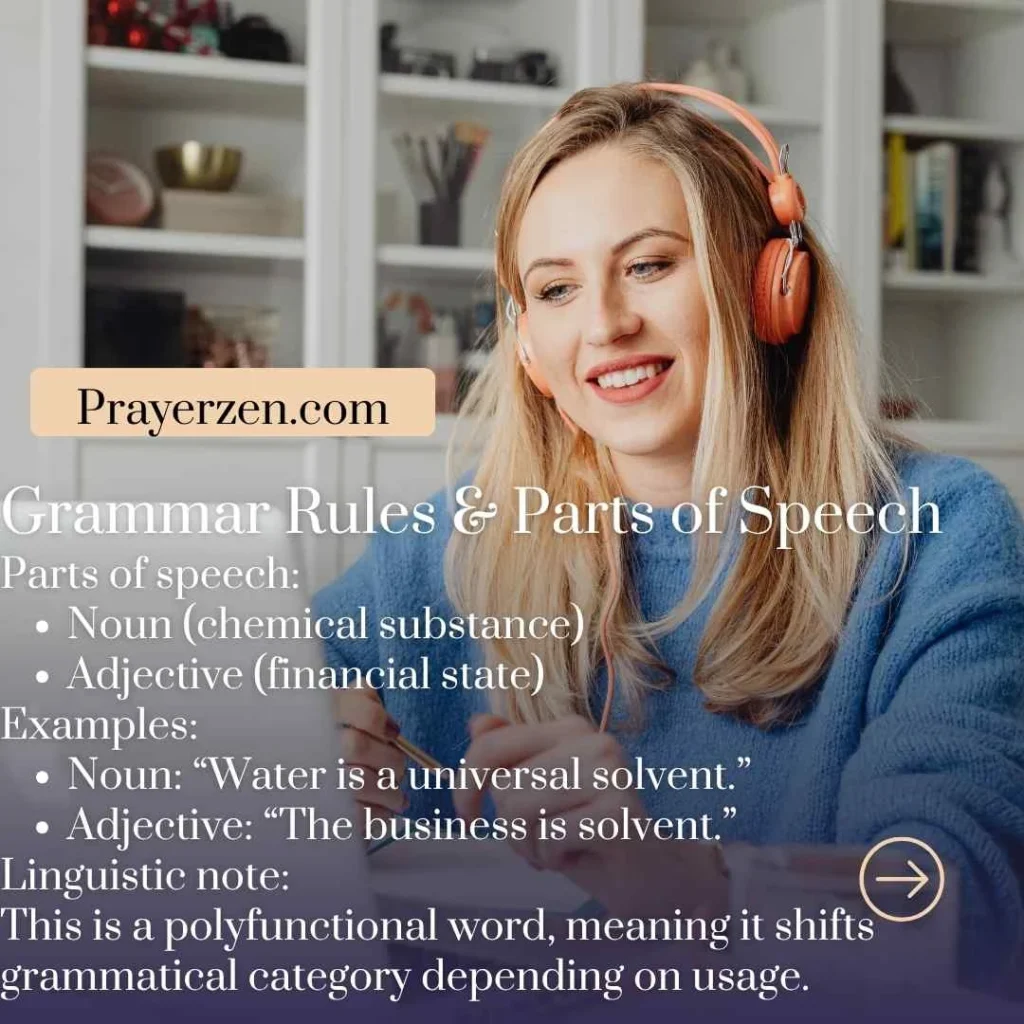
Parts of speech:
- Noun (chemical substance)
- Adjective (financial state)
Examples:
- Noun: “Water is a universal solvent.”
- Adjective: “The business is solvent.”
Linguistic note:
This is a polyfunctional word, meaning it shifts grammatical category depending on usage.
Synonyms and Antonyms
Chemical context synonyms:
- Dissolver
- Medium
- Liquid agent
Financial context synonyms:
- Stable
- Secure
- Creditworthy
Antonyms:
- Insolvent
- Bankrupt
- Insoluble (chemical opposite in concept)
Formal vs Informal Usage
Formal usage:
- “The company remains solvent despite economic pressure.”
- “Ethanol is a polar solvent used in labs.”
Informal usage:
- “The business is still solvent, luckily.”
- “Water is like a universal solvent for experiments.”
Illustrative Examples
- Water is the most common solvent in nature.
- The company is solvent after restructuring its debt.
- Acetone acts as a powerful organic solvent.
- A solvent business attracts investors easily.
- Salt dissolves easily in a solvent like water.
- The bank confirmed the client is financially solvent.
- Alcohol can serve as a solvent in chemical reactions.
- The solvent properties of water make it essential for life.
- Despite losses, the firm remains solvent.
- Scientists tested different solvents in the lab.
- A solvent is required to dissolve the compound.
- The entrepreneur ensured his startup stayed solvent.
Practice Section (15 MCQs)
1. A solvent in chemistry is:
A) A solid
B) A gas only
C) A substance that dissolves others
D) A reaction
2. The financial meaning of solvent is:
A) Poor
B) Rich in assets
C) Insolvent
D) Borrowing money
3. The root of solvent comes from:
A) Greek
B) Latin
C) Arabic
D) Sanskrit
4. Water is an example of:
A) Solute
B) Solvent
C) Gas
D) Acid
5. Opposite of solvent (finance):
A) Stable
B) Insolvent
C) Liquid
D) Strong
6. Solvent in chemistry usually means:
A) Solid state
B) Liquid medium
C) Gas only
D) Plasma
7. The word solvent is:
A) Only a noun
B) Only a verb
C) Noun and adjective
D) Preposition
8. Solvent means “to dissolve” comes from:
A) German
B) Latin
C) French
D) Italian
9. A solvent company can:
A) Avoid taxes
B) Pay debts
C) Print money
D) Borrow endlessly
10. Acetone is a:
A) Metal
B) Solvent
C) Salt
D) Gas
11. Semantic extension means:
A) Word shortening
B) Meaning expansion
C) Spelling change
D) Grammar rule
12. Solvent rhymes with:
A) Moment
B) Silent
C) Talent
D) Agent
13. Water is called universal solvent because:
A) It is rare
B) It dissolves many substances
C) It is solid
D) It is acidic
14. Financial solvent means:
A) Bankrupt
B) Debt-free ability
C) Borrowing
D) Losing money
15. Plural of solvent is:
A) Solventes
B) Solvents
C) Solventi
D) Solvants
Answer Key:
1-C, 2-B, 3-B, 4-B, 5-B, 6-B, 7-C, 8-B, 9-B, 10-B, 11-B, 12-A, 13-B, 14-B, 15-B
Frequently Asked Questions (FAQs)
1. What does solvent mean in simple words?
It means a substance that dissolves something or a financially stable entity.
2. Is water a solvent?
Yes, water is the most common universal solvent.
3. What does solvent mean in business?
It means a company can pay its debts and is financially stable.
4. Is solvent the same as solution?
No, solvent dissolves; solution is the final mixture.
5. What is opposite of solvent?
In finance, it is insolvent.
Conclusion
The word solvent is a perfect example of how language evolves across disciplines.
It carries both scientific and financial meanings rooted in the idea of “dissolving” or “resolving.”
In chemistry, it enables reactions and mixtures.
In finance, it reflects stability and economic health.
Understanding both meanings helps you avoid confusion in academic and professional settings.
Once you see the connection between literal and metaphorical use, the word becomes much easier to remember and apply correctly.

Jack Hollis
Jack Hollis ne apni zindagi ka hamesha ye maqsad rakha hai ke wo logon ke dilon tak roohani raahnumai aur tasalli pahunchaye. Unhe likhne ka shauq bachpan se tha, aur aaj wo apni writings ke zariye faith aur hope ko logon tak pohanchate hain. Jack ka yakeen hai ke har insaan ke andar qudrati roshni aur dua ki taqat hoti hai, jo mushkil waqt me himmat aur sukoon deti hai. Unki writing simple, dil ko choo lene wali aur rozmarra ki zindagi se related hoti hai. Wo readers ko inspire karte hain ke wo apni prayers aur faith ko apni zindagi ka hissa banayein.
Books:
-
Whispers of Hope
-
Guided by Faith