Table of Contents
- Introduction
- Direct Answer: What Hybrid Remote Means
- Quick Comparison Table
- Deep Meanings & Definitions
- Historical Origin & Etymology
- Pronunciation Guide
- The Technical Differences Behind Hybrid Remote Work
- Correct Spelling & Common Typos
- Mnemonic Devices (Memory Tricks)
- Regional Variations (US vs. UK English)
- Singular and Plural Forms
- Grammar Rules & Parts of Speech
- Synonyms and Antonyms
- Formal vs. Informal Usage
- Illustrative Examples
- Practice Section (15 MCQs)
- Frequently Asked Questions (FAQs)
- Conclusion
Introduction
I still remember when “working from home” suddenly became the new normal, and everyone started asking what happens next. That’s when the term hybrid remote began appearing everywhere.
If you’ve ever seen job listings mentioning hybrid remote work and felt unsure about what it actually means, you’re not alone. Many people confuse it with fully remote or flexible work setups.
Understanding this term is important because it directly affects how you work, commute, and manage your career expectations.
In today’s world, companies are reshaping workplace structures faster than ever before.
Knowing exactly what hybrid remote means helps you make smarter job decisions and avoid misunderstandings with employers.
Let’s break it down clearly and deeply so you never get confused again.
Direct Answer: What Hybrid Remote Means
Hybrid remote work refers to a flexible work model where employees split their time between working remotely (usually from home) and working in a physical office. The schedule may be fixed (specific office days) or flexible depending on company policy, combining both in-person collaboration and remote independence.
Quick Comparison Table
| Feature | Hybrid Remote | Fully Remote | Office-Based |
| Work Location | Home + Office | Home only | Office only |
| Flexibility | Medium to High | Very High | Low |
| Collaboration | Mixed | Virtual only | In-person |
| Commute | Part-time | None | Daily |
| Structure | Flexible schedule | Fully flexible | Fixed hours |
Deep Meanings & Definitions
Hybrid Remote Meaning
The term hybrid remote combines two workplace models:
- Hybrid → mixture of two systems
- Remote → working outside a traditional office
So, hybrid remote means employees operate partly from home and partly from office environments.
Core Idea
It balances:
- Flexibility of remote work
- Structure of office work
This model is widely adopted by modern companies to improve productivity and employee satisfaction.
Historical Origin & Etymology

Hybrid
- Comes from Latin “hybrida”, meaning mixed origin
- Originally used in biology for mixed species
Remote
- Comes from Latin “remotus”, meaning far away
- Evolved to describe distant working or communication
Modern Workplace Use
The combination “hybrid remote” became popular after global shifts in workplace culture during the early 2020s, when remote work adoption increased dramatically.
Pronunciation Guide
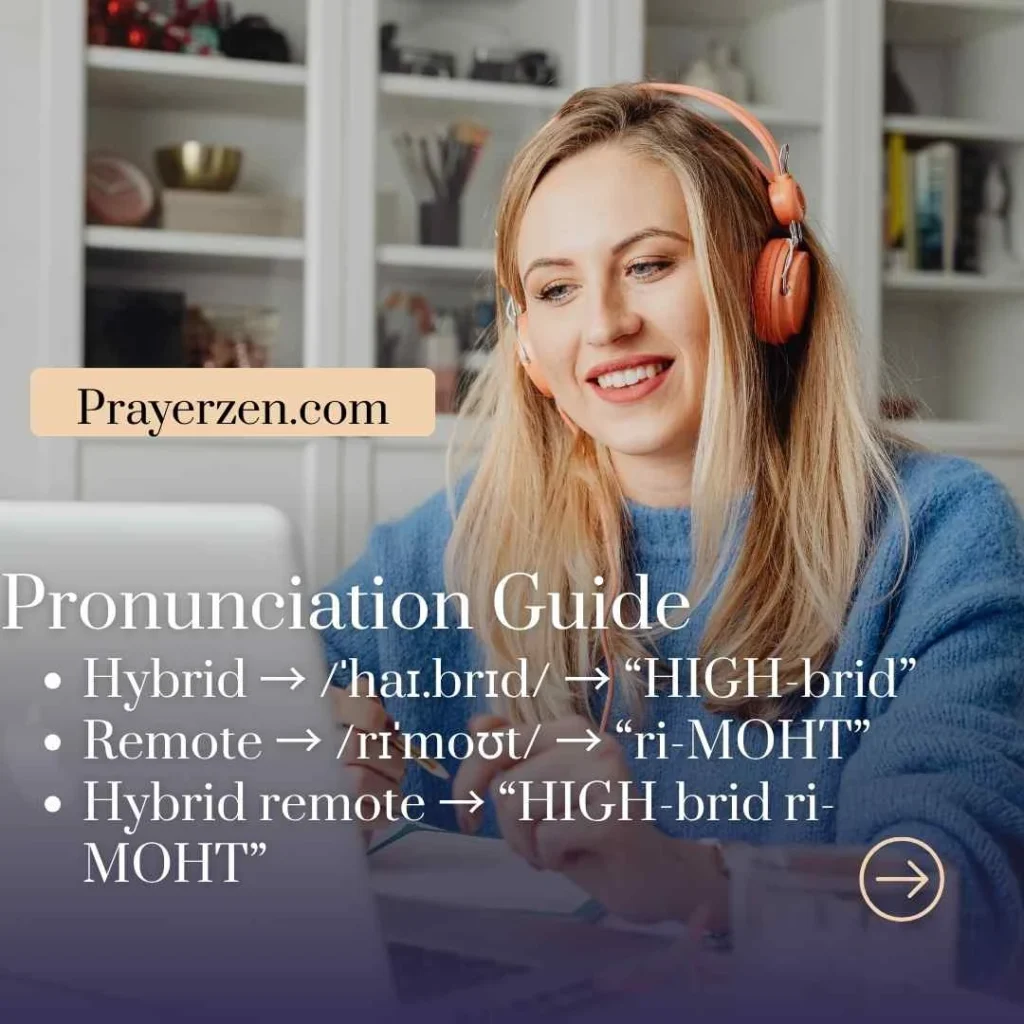
- Hybrid → /ˈhaɪ.brɪd/ → “HIGH-brid”
- Remote → /rɪˈmoʊt/ → “ri-MOHT”
- Hybrid remote → “HIGH-brid ri-MOHT”
Think: “High bridge leads to remote work freedom.”
The Technical Differences Behind Hybrid Remote Work
Hybrid remote work differs from other models in several key ways:
1. Work Location Flexibility
Employees switch between:
- Office environment
- Remote/home environment
2. Schedule Structure
Two main types:
- Fixed hybrid (e.g., Mon–Wed office)
- Flexible hybrid (employee chooses days)
3. Communication Style
- Office days → in-person meetings
- Remote days → digital communication tools
4. Productivity Model
Companies aim to:
- Boost collaboration in office
- Increase focus time at home
Why Confusion Happens
People confuse hybrid remote with:
- Fully remote jobs
- Freelance work
- Flexible hours
But hybrid remote is specifically about location-based splitting of work time.
Correct Spelling & Common Typos
Common Mistakes
- “hybird remote” ❌
- “hybrid remot” ❌
- “hyprid remote” ❌
- “hybrid remotee” ❌
Why Errors Occur
- Fast typing
- Phonetic spelling mistakes
- Lack of familiarity with workplace jargon
Mnemonic Devices (Memory Tricks)
Remember this simple trick:
“HYBRID = Half You Between Remote In-office Days”
Or:
“Hybrid = Home + Office blended reality”
Regional Variations (US vs. UK English)
Good news:
There are no spelling differences between US and UK English for “hybrid remote.”
However:
- UK companies may use “hybrid working” more often
- US companies prefer “hybrid remote jobs”
Singular and Plural Forms
- Hybrid remote job → Hybrid remote jobs
- Hybrid model → Hybrid models
- Remote workday → Remote workdays
Possessive:
- Hybrid remote’s flexibility
- Hybrid model’s structure
Grammar Rules & Parts of Speech
- Hybrid → adjective (describes type of system)
- Remote → adjective (describes location)
- Together → compound adjective phrase
Example:
- “Hybrid remote work is becoming popular.”
Synonyms and Antonyms
Synonyms
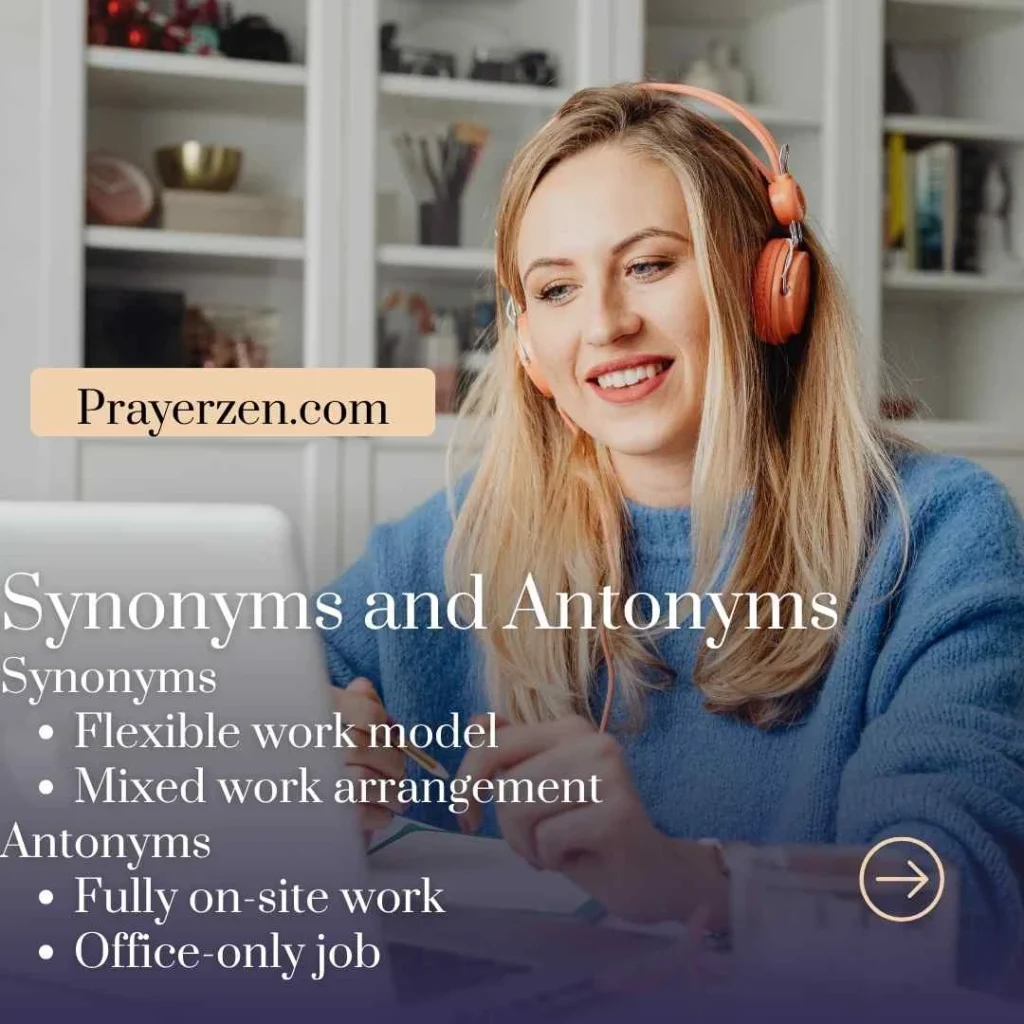
- Flexible work model
- Blended work system
- Mixed work arrangement
Antonyms
- Fully on-site work
- Office-only job
- Traditional workplace model
Formal vs. Informal Usage
Formal Usage
- “The company offers a hybrid remote work policy.”
- “Employees follow a hybrid working schedule.”
Informal Usage
- “I work hybrid now.”
- “My job is half office, half home.”
Illustrative Examples
- She works in a hybrid remote setup.
- The company offers hybrid remote jobs.
- Hybrid remote work improves flexibility.
- Employees come to office twice a week.
- He prefers hybrid remote over full office work.
- Hybrid remote models boost productivity.
- Meetings happen on office days.
- Remote days are used for focused tasks.
- Many tech companies use hybrid remote systems.
- Hybrid remote policies vary by organization.
- Workers enjoy better work-life balance.
- Hybrid remote reduces commuting stress.
Practice Section (15 MCQs)
- What does hybrid remote mean?
A) Only office work
B) Only home work
C) Mix of home and office - Hybrid remote includes:
A) Traveling
B) Office + remote work
C) Freelancing only - Remote means:
A) Far away work
B) Office work
C) No work - Hybrid is derived from:
A) Greek
B) Latin
C) French - Hybrid remote allows:
A) Fixed office only
B) Flexible location
C) No structure - Employees in hybrid work:
A) Never visit office
B) Split time
C) Only travel - Remote work is done from:
A) Home or any place
B) Office only
C) Factory - Hybrid remote became popular after:
A) Industrial revolution
B) 2020 global shift
C) 1800s - Hybrid remote is mainly about:
A) Salary
B) Location flexibility
C) Job title - Opposite of hybrid remote is:
A) Freelance
B) Office-only
C) Online work - Hybrid remote improves:
A) Commute stress
B) Job rejection
C) Travel time - Hybrid remote includes:
A) Only meetings
B) Both in-person and online work
C) Only coding - Hybrid means:
A) Single system
B) Mixed system
C) Broken system - Remote comes from:
A) Latin
B) Arabic
C) German - Hybrid remote is common in:
A) Modern companies
B) Ancient systems
C) Agriculture only
Answer Key
1-C, 2-B, 3-A, 4-B, 5-B, 6-B, 7-A, 8-B, 9-B, 10-B, 11-A, 12-B, 13-B, 14-A, 15-A
Frequently Asked Questions (FAQs)
1. Is hybrid remote the same as work from home?
No, hybrid remote includes both office and home work.
2. Do hybrid remote jobs require office visits?
Yes, usually part-time office attendance is required.
3. Is hybrid remote flexible?
Yes, but flexibility depends on company policy.
4. Which is better: remote or hybrid?
It depends on personal preference and job type.
5. Can hybrid remote become fully remote?
Sometimes companies shift policies over time.
Conclusion
Hybrid remote work represents a modern balance between flexibility and structure. It allows employees to enjoy the benefits of working from home while still maintaining in-person collaboration at the office.
As workplace culture continues to evolve, understanding this model helps you make better career decisions.
Whether you prefer structure or flexibility, hybrid remote is shaping the future of work in powerful ways.

Julian Gray
Hello, I’m Julian Gray, a writer and seeker of spiritual wisdom. My journey began with a simple curiosity about the power of prayers and how they shape our daily lives. Over the years, I’ve explored different traditions, meditations, and practices, always looking for ways to bring peace and clarity to the heart. Writing allows me to share these insights with readers who, like me, are searching for hope, inspiration, and connection. I believe that even small acts of prayer can transform our world in meaningful ways. Through my words, I aim to encourage reflection, gratitude, and a deeper understanding of life.
Books:
-
Whispers of the Soul
-
Paths to Peace