
Table of Contents
- Introduction
- Direct Answer
- Quick Comparison Table
- Deep Meanings & Definitions
- Historical Origin & Etymology
- Pronunciation Guide
- The Technical Differences
- Correct Usage & Common Misunderstandings
- Mnemonic Devices (Memory Tricks)
- Regional Variations (US vs. UK English)
- Singular and Plural Forms
- Grammar Rules & Parts of Speech
- Synonyms and Antonyms
- Formal vs. Informal Usage
- Illustrative Examples
- Practice Section (15 MCQs)
- Frequently Asked Questions (FAQs)
- Conclusion
Introduction
I often notice that the word authority is used in many different ways, yet most people cannot clearly explain what it actually means.
Sometimes it refers to power, sometimes to expertise, and other times to official permission. This confusion is completely normal because the word operates across legal, social, academic, and linguistic contexts.
If you’ve ever wondered why someone is called an “authority on a subject” while another person has “legal authority,” you’re not alone.
In this guide, I will break down what authority really means, how it evolved, and how you should use it correctly in everyday English.
By the end, you’ll understand both the linguistic structure and real-world applications of the word.
Let’s make this concept simple, clear, and practical.
Direct Answer
Authority means the power, right, or ability to make decisions, enforce rules, or give expert knowledge in a specific area. It can refer to official control (like government power) or expertise (like being an authority on a subject).
Quick Comparison Table
| Aspect | Authority |
| Spelling | A-U-T-H-O-R-I-T-Y |
| Core Meaning | Power, control, or expertise |
| Usage | Legal, social, academic, professional contexts |
Deep Meanings & Definitions
The word authority has multiple layers of meaning:
1. Legal Authority
Refers to the official power granted by law or institution:
- Governments
- Police
- Courts
- Organizations
2. Social Authority
Refers to influence or dominance in society or groups:
- Parents over children
- Leaders over teams
3. Expert Authority
Refers to recognized knowledge or expertise:
- Doctors
- Scientists
- Professors
Key Idea:
Authority always involves recognized legitimacy, not just force or opinion.
Historical Origin & Etymology
The word authority comes from Latin:
- Latin root: “auctoritas”
- Derived from “auctor” meaning creator, promoter, or author
Evolution:
- Latin → Old French (autorité)
- Middle English → autorite
- Modern English → authority
Originally, it meant the power of an author or creator to influence others, which later evolved into legal and social power.
Pronunciation Guide
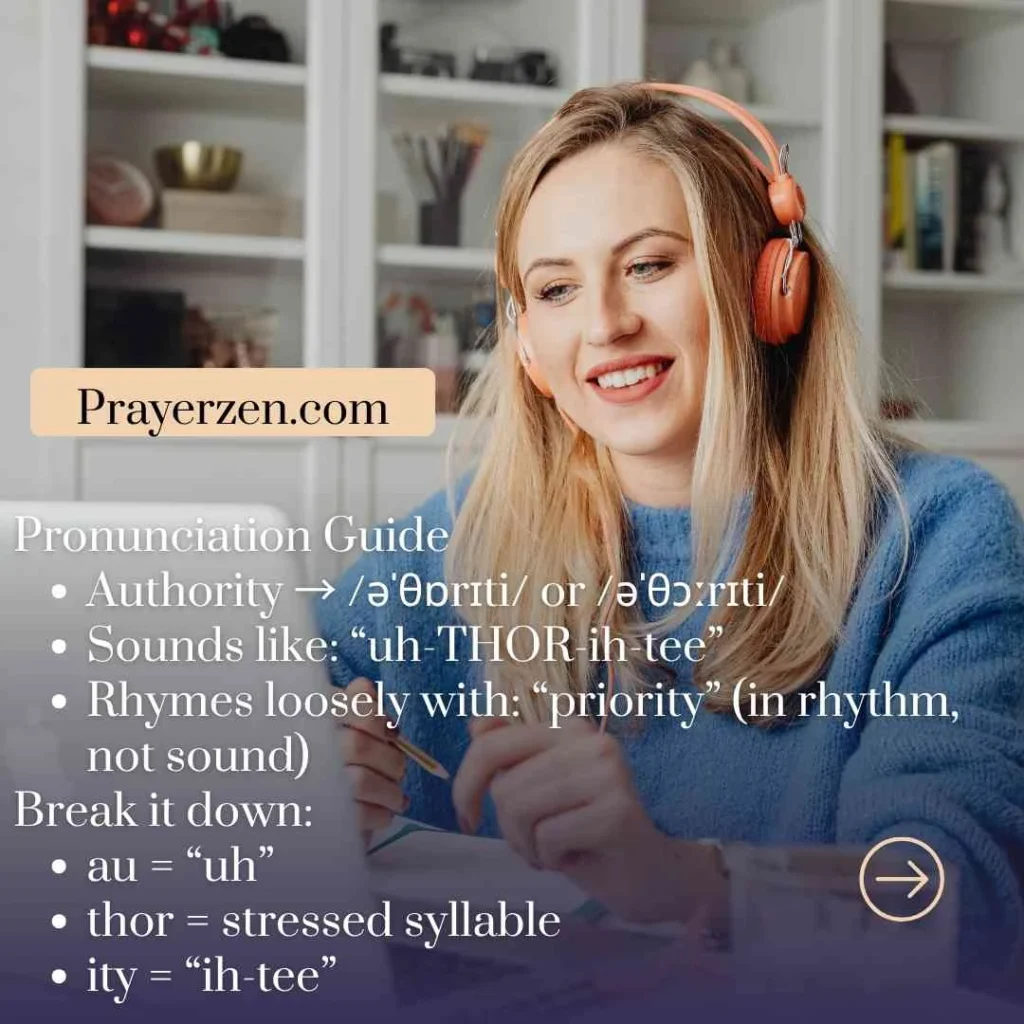
- Authority → /əˈθɒrɪti/ or /əˈθɔːrɪti/
- Sounds like: “uh-THOR-ih-tee”
- Rhymes loosely with: “priority” (in rhythm, not sound)
Break it down:
- au = “uh”
- thor = stressed syllable
- ity = “ih-tee”
The Technical Differences
People often confuse authority with similar concepts:
Authority vs Power
- Authority → Legitimized control
- Power → Ability to influence, even without permission
Authority vs Control
- Authority → Recognized right
- Control → Actual execution or dominance
Authority vs Expertise
- Authority → Can include expertise
- Expertise → Knowledge without necessarily having power
Correct Usage & Common Misunderstandings
Common Confusions:
- Thinking authority means only government power
- Assuming authority = physical control
- Misusing “authorities” for individuals instead of institutions
Correct Understanding:
Authority always implies:
- Recognition
- Legitimacy
- Acceptance by others
Mnemonic Devices (Memory Tricks)
Remember this simple trick:
“Author gives authority.”
- Author → creates ideas
- Authority → gives recognized power to those ideas
Or:
“Authority = Authorized power.”
Regional Variations (US vs. UK English)
Good news: the spelling authority is the same worldwide.
However:
- UK English often emphasizes formal usage in law and government contexts
- US English uses it more broadly in business and management
Meaning stays consistent across regions.
Singular and Plural Forms
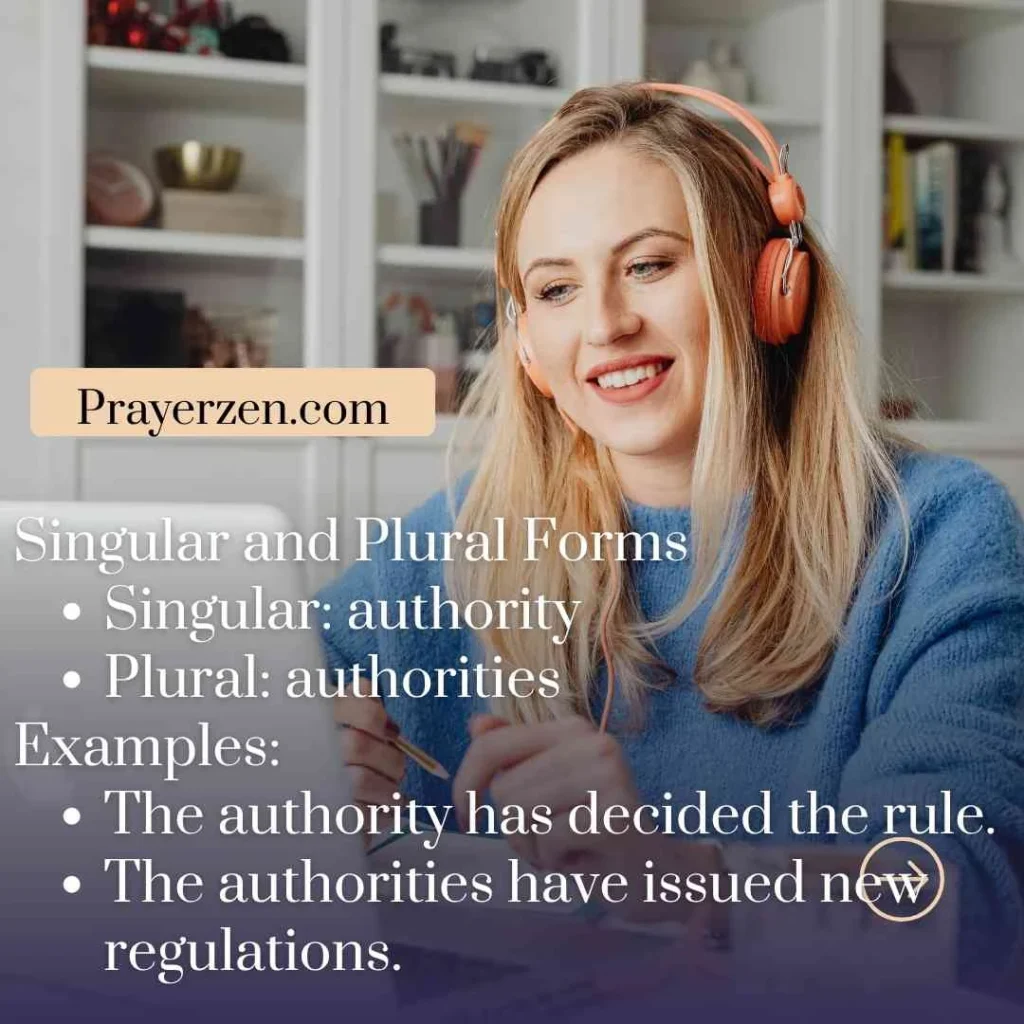
- Singular: authority
- Plural: authorities
Examples:
- The authority has decided the rule.
- The authorities have issued new regulations.
Possessive form:
- authority’s decision
- authorities’ policies
Grammar Rules & Parts of Speech
As a Noun (Primary Use)
- The main meaning is noun form
Types of Usage:
- Countable: authorities (organizations or bodies)
- Uncountable: authority (concept of power/expertise)
Example:
- She has authority in linguistics.
Synonyms and Antonyms
Synonyms:
- Power
- Control
- Command
- Jurisdiction
- Expertise
- Influence
Antonyms:
- Weakness
- Subordination
- Powerlessness
- Incompetence
Formal vs. Informal Usage
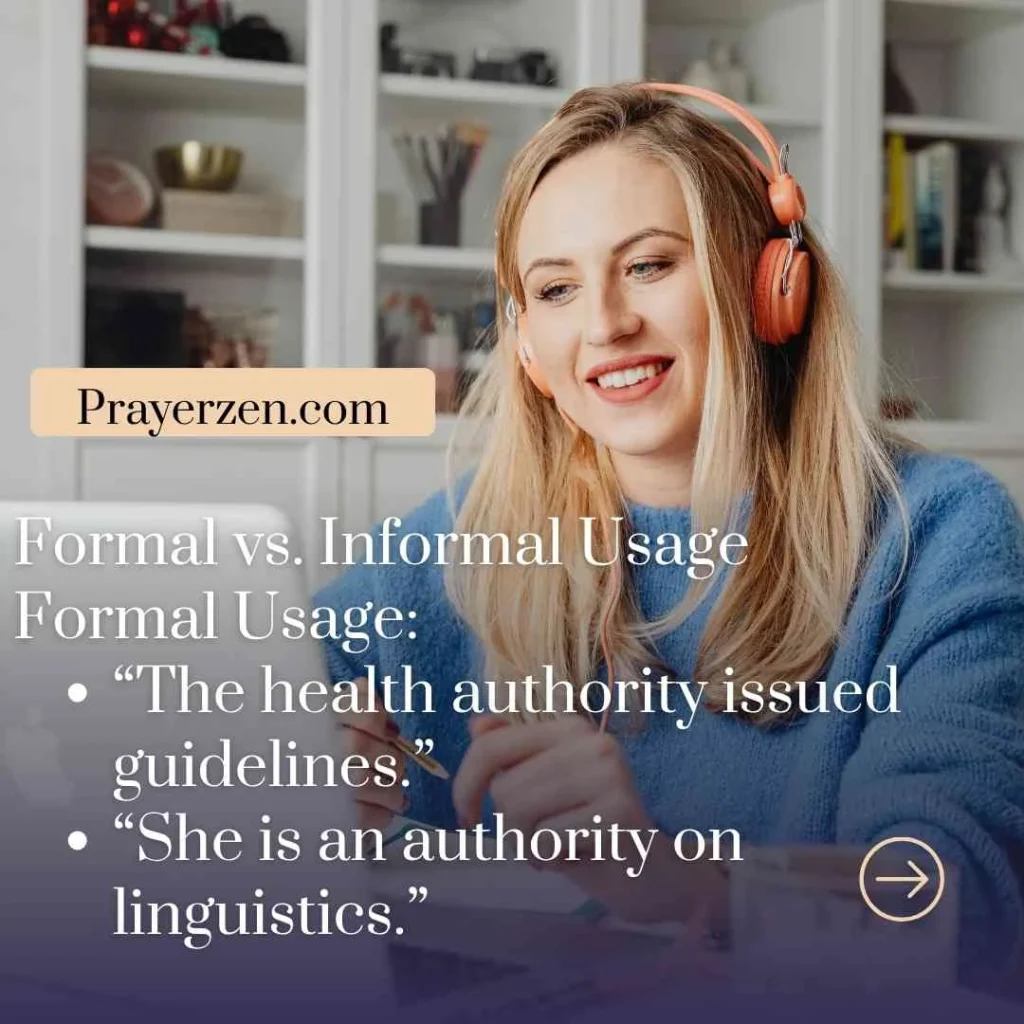
Formal Usage:
- “The health authority issued guidelines.”
- “She is an authority on linguistics.”
Informal Usage:
- “He acts like he has authority over everything.”
- “She’s the authority on this topic.”
Illustrative Examples
- The government authority announced new rules.
- She is an authority on ancient languages.
- Police authority increased in the region.
- Teachers have authority in classrooms.
- The health authorities issued a warning.
- He speaks with authority on economics.
- No one questioned her authority.
- Local authorities managed the crisis.
- Authority must be exercised responsibly.
- He lacks authority in this matter.
- The regulatory authority approved the project.
- She wrote a book as an authority on history.
Practice Section (15 MCQs)
- What does authority mainly mean?
A) Weakness
B) Power or expertise
C) Confusion - Authority comes from which language?
A) Greek
B) Latin
C) Arabic - Which is a synonym of authority?
A) Control
B) Failure
C) Silence - Authorities (plural) refers to:
A) One person
B) Organizations or bodies
C) Objects - Expert authority means:
A) Physical strength
B) Knowledge in a field
C) Political rule - Authority is primarily a:
A) Verb
B) Noun
C) Adjective - “Police authority” refers to:
A) Fiction
B) Legal power
C) Weather - Authority vs power difference is:
A) Same meaning
B) Legitimacy vs ability
C) Grammar difference - Which is NOT a synonym?
A) Influence
B) Control
C) Weakness - “Authoritas” is from:
A) French
B) Latin
C) German - A professor is an authority in:
A) Fashion
B) Subject expertise
C) Sports only - Authority is always:
A) Unofficial
B) Legitimate
C) Random - “Authorities issued rules” means:
A) One person
B) Official bodies
C) Students - Opposite of authority is:
A) Power
B) Weakness
C) Control - Authority in grammar is mainly:
A) Verb
B) Noun
C) Adverb
Answer Key
1-B, 2-B, 3-A, 4-B, 5-B, 6-B, 7-B, 8-B, 9-C, 10-B, 11-B, 12-B, 13-B, 14-B, 15-B
Frequently Asked Questions (FAQs)
1. What is the simple meaning of authority?
It means the power or right to make decisions or the expertise in a subject.
2. Is authority always about government power?
No, it also includes expertise and social influence.
3. What is the plural of authority?
The plural form is authorities.
4. Can a person be an authority?
Yes, especially when they are experts in a field.
5. What is the origin of authority?
It comes from the Latin word auctoritas.
Conclusion
Authority is a powerful and flexible word that covers power, control, and expertise depending on context.
It originates from Latin and has evolved into a concept used in law, society, and education.
Understanding authority helps you communicate more precisely in both academic and real-world settings.
Whether you are referring to governments or experts, the core idea remains recognized legitimacy.
Mastering this word improves both your vocabulary and conceptual clarity.
Use it wisely, and you will express ideas with greater confidence and accuracy.

Olivia Brooks
Hi, I’m Olivia Brooks, a passionate writer and believer in the power of words and prayers. Ever since I can remember, I’ve found comfort and inspiration in sharing thoughts that uplift the soul. Writing, for me, is not just a craft—it’s a way to connect hearts and bring hope to those who need it most. I love exploring the delicate balance between faith, life challenges, and finding peace in everyday moments. Through my stories, I hope to remind everyone that even in the darkest times, a little prayer can light the way. When I’m not writing, you’ll find me enjoying quiet mornings with a cup of tea and my journal.
Books by Olivia Brooks:
-
Whispers of the Soul
-
Light in the Shadows