

Table of Contents
- Introduction
- Direct Answer
- Quick Comparison Table
- Deep Meanings & Definitions
- Historical Origin & Etymology
- Pronunciation Guide
- The Technical Differences
- Correct Interpretation & Common Misunderstandings
- Mnemonic Devices (Memory Tricks)
- Regional Variations (US vs. UK Weather Forecasting)
- Singular and Plural Forms in Weather Language
- Grammar Rules & Parts of Speech
- Synonyms and Antonyms
- Formal vs. Informal Usage
- Illustrative Examples
- Practice Section (15 MCQs)
- Frequently Asked Questions (FAQs)
- Conclusion
Introduction
I often hear people look at a weather app and feel confused when they see “30% chance of rain.”
Many assume it means it will rain for 30% of the day, or that 30% of the area will get wet.
This misunderstanding is extremely common and leads to poor planning decisions.
In reality, this percentage is based on meteorological probability models, not simple duration or coverage.
Understanding it correctly helps you plan travel, events, and daily activities more confidently.
In this guide, I will break down exactly what this number means in simple, expert-level terms.
By the end, you’ll read weather forecasts like a professional.
Direct Answer
A 30% chance of rain means there is a 30% probability that measurable rainfall (0.01 inches or more) will occur at a specific location during the forecast period. It does NOT mean it will rain for 30% of the day or cover 30% of the area. It is a statistical likelihood based on weather data and model predictions.
Quick Comparison Table
| Aspect | Meaning of 30% Chance of Rain |
| Term | Probability of Precipitation (PoP) |
| Meaning | 30% likelihood of measurable rain |
| Core Usage | Weather forecasting and planning |
| Misconception | Not duration or area coverage |
| Interpretation | Risk-based probability model |
Deep Meanings & Definitions
The term “30 chance of rain” comes from meteorology and refers to a concept called Probability of Precipitation (PoP).
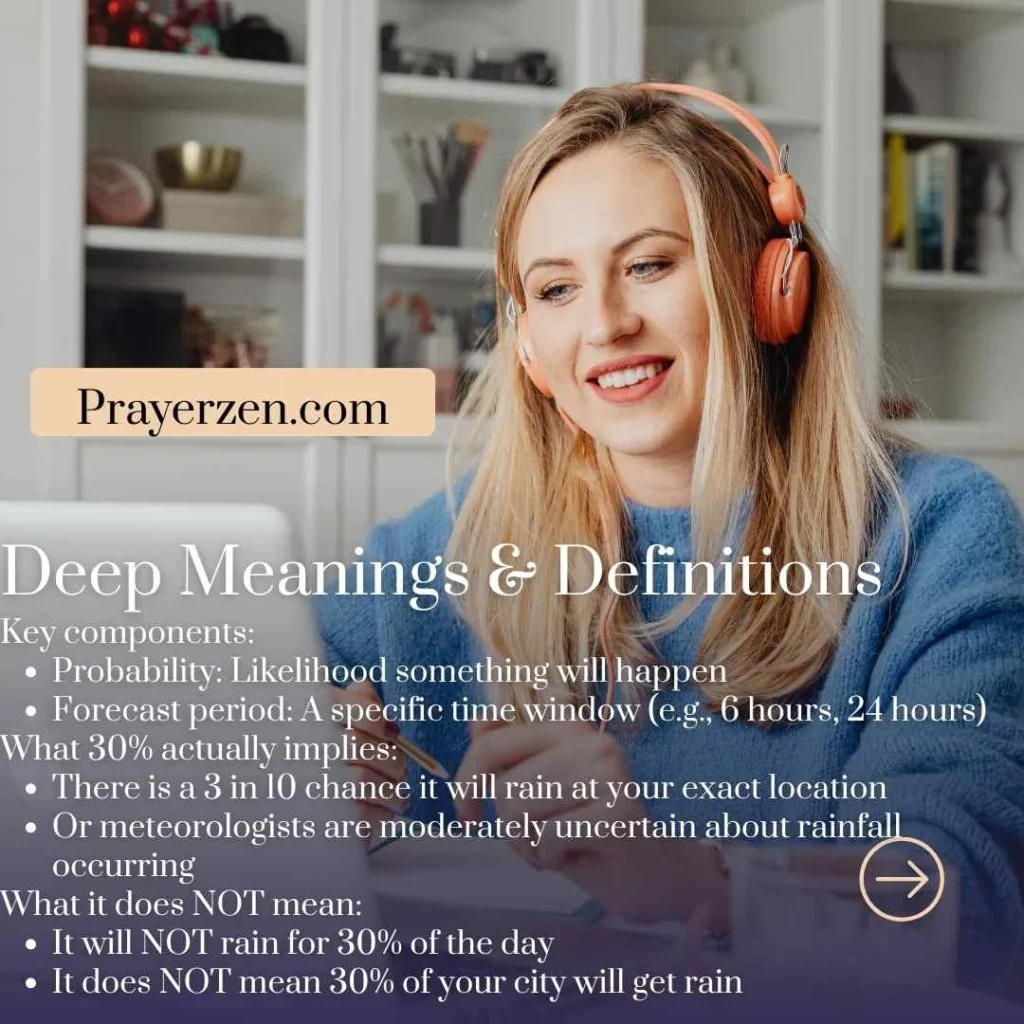
Key components:
- Probability: Likelihood something will happen
- Precipitation: Rain, drizzle, or measurable moisture
- Forecast period: A specific time window (e.g., 6 hours, 24 hours)
What 30% actually implies:
- There is a 3 in 10 chance it will rain at your exact location
- Or meteorologists are moderately uncertain about rainfall occurring
- It reflects model data, atmospheric conditions, and historical patterns
What it does NOT mean:
- It will NOT rain for 30% of the day
- It does NOT mean 30% of your city will get rain
- It is NOT a measurement of intensity
Historical Origin & Etymology
The concept of probability-based weather forecasting developed in the 20th century as meteorology became more mathematical.
Origin of “Probability of Precipitation”
- Introduced by meteorologists using statistical models
- Became standardized in U.S. forecasting in the mid-1900s
- Based on numerical weather prediction systems
Linguistic breakdown:
- Probability → from Latin probabilitas meaning “likelihood”
- Precipitation → from Latin praecipitatio, meaning “a falling down”
- Combined meaning: “likelihood of falling water from the sky”
Modern forecasting uses supercomputers and atmospheric data to calculate this percentage.
Pronunciation Guide
- 30% → “thirty percent”
- Chance → /ʧæns/ (rhymes with “dance”)
- Rain → /reɪn/ (rhymes with “train”)
Full phrase:
“thirty percent chance of rain”
Simple spoken meaning: “There’s some possibility it may rain.”
The Technical Differences
Many people misinterpret weather percentages because they confuse three different meteorological ideas:

1. Probability of rain
- Chance it will rain at all in your location
2. Coverage area
- How much of the region will experience rain
3. Duration
- How long rainfall may last
Why confusion happens:
- Weather apps simplify complex data
- Humans prefer concrete expectations
- Percentage looks like a quantity, not a probability
The real formula (simplified):
PoP = Confidence × Coverage
So 30% could mean:
- 100% confidence × 30% area coverage
OR - 30% confidence × 100% coverage
Correct Interpretation & Common Misunderstandings
Common mistakes:
- Thinking it will rain for 30% of the day
- Assuming light rain is guaranteed
- Believing 70% means “mostly dry everywhere”
Correct understanding:
- It is a risk indicator, not a schedule
- Rain may happen briefly or not at all
- It depends on where you are exactly
Mnemonic Devices (Memory Tricks)
To remember it easily:
“30% means 3 chances out of 10 it rains where YOU are.”
Or:
“It’s a dice roll, not a timeline.”
This helps reinforce:
- It is probability-based
- It is location-specific
- It is not duration-based
Regional Variations (US vs. UK Weather Forecasting)
United States:
- Uses Probability of Precipitation (PoP) percentages
- Very precise statistical modeling
United Kingdom:
- Often uses terms like:
- “Slight chance of rain”
- “Scattered showers”
- Less emphasis on exact percentages in casual forecasts
Canada & Australia:
- Mix of percentage-based and descriptive forecasts
- Increasing use of PoP like the US system
Singular and Plural Forms in Weather Language
Correct usage:
- Singular: “a chance of rain”
- Plural: “chances of rain in different regions”
Examples:
- “There is a 30% chance of rain today.”
- “Multiple chances of rain are expected this week.”
Possessive form:
- “The forecast’s chance of rain is 30%.”
Grammar Rules & Parts of Speech
Breakdown:
- 30% → quantifier
- chance → noun
- of rain → prepositional phrase
Sentence function:
- Acts as a noun phrase describing probability
Example:
“A 30% chance of rain is forecast.”
Synonyms and Antonyms

Synonyms:
- Slight chance of rain
- Low probability of precipitation
- Scattered showers likely
- Partial rain risk
Antonyms:
- 0% chance of rain
- Clear skies
- No precipitation expected
- Dry conditions
Formal vs. Informal Usage
Formal:
- “There is a 30% probability of precipitation today.”
Informal:
- “It might rain a little today.”
Usage context:
- Weather reports → formal
- Daily conversation → informal
Illustrative Examples
- There is a 30% chance of rain this afternoon.
- The forecast shows a low probability of showers.
- A 30% chance means rain is possible but not likely.
- We might get a brief shower later today.
- The weather app predicts scattered rainfall.
- There is a small risk of precipitation tonight.
- A 30% chance does not guarantee rain.
- It could rain, but most areas may stay dry.
- The forecast suggests uncertain weather conditions.
- There is a moderate chance of isolated showers.
- The probability of rain is relatively low.
- You may want to carry an umbrella just in case.
Practice Section (15 MCQs)
1. What does 30% chance of rain mean?
A) Rain for 30% of the day
B) 30% probability of rain
C) 30% of area gets rain
D) Guaranteed light rain
2. It is also called:
A) Temperature Index
B) Probability of Precipitation
C) Humidity Ratio
D) Wind Factor
3. 30% chance means:
A) Certain rain
B) No rain
C) Possible rain
D) Heavy rain
4. It is based on:
A) Guesswork
B) Mathematical models
C) Astrology
D) Random selection
5. It does NOT measure:
A) Probability
B) Duration
C) Risk
D) Forecast
6. 30% means:
A) 3 out of 10 chance
B) 30 hours of rain
C) 30 drops of rain
D) 30 storms
7. Weather forecasting uses:
A) Superstitions
B) Atmospheric data
C) Dreams
D) Rumors
8. UK often uses:
A) Percentages only
B) Descriptive terms
C) No forecasts
D) Astrology
9. 30% chance is:
A) High probability
B) Moderate to low probability
C) Guaranteed rain
D) Impossible rain
10. It depends on:
A) Exact location
B) Zodiac signs
C) Moon phase
D) Time zone only
11. PoP stands for:
A) Point of Pressure
B) Probability of Precipitation
C) Pattern of Pressure
D) Prediction of Places
12. 0% chance means:
A) Light rain
B) No expected rain
C) Heavy rain
D) Storm
13. It is NOT:
A) Probability
B) Guarantee
C) Forecast
D) Estimate
14. “Chance of rain” is a:
A) Verb
B) Noun phrase
C) Adjective
D) Preposition
15. Best interpretation:
A) Exact timing of rain
B) Risk-based probability
C) Guaranteed storm
D) Rain duration
Answer Key:
1-B, 2-B, 3-C, 4-B, 5-B, 6-A, 7-B, 8-B, 9-B, 10-A, 11-B, 12-B, 13-B, 14-B, 15-B
Frequently Asked Questions (FAQs)
1. Does 30% chance of rain mean it will rain?
No, it means there is a 30% probability of rain occurring.
2. Does it rain for 30% of the day?
No, this is a common misconception.
3. Is 30% chance high?
It is considered low to moderate risk.
4. Should I carry an umbrella?
Yes, if you want to stay prepared for light rain.
5. What is the most accurate interpretation?
It is a probability estimate of rainfall at your location.
Conclusion
The phrase “what does 30 chance of rain mean” is often misunderstood, but it simply represents probability, not duration or coverage.
It tells you the likelihood of rain occurring at your location.
It does not guarantee rain or describe how long it will last.
Instead, it helps you make informed planning decisions.
Understanding this concept improves how you read weather forecasts.
Once mastered, you can interpret any percentage with confidence.
Weather becomes less confusing and far more predictable in mindset.

Olivia Brooks
Hi, I’m Olivia Brooks, a passionate writer and believer in the power of words and prayers. Ever since I can remember, I’ve found comfort and inspiration in sharing thoughts that uplift the soul. Writing, for me, is not just a craft—it’s a way to connect hearts and bring hope to those who need it most. I love exploring the delicate balance between faith, life challenges, and finding peace in everyday moments. Through my stories, I hope to remind everyone that even in the darkest times, a little prayer can light the way. When I’m not writing, you’ll find me enjoying quiet mornings with a cup of tea and my journal.
Books by Olivia Brooks:
-
Whispers of the Soul
-
Light in the Shadows