
Table of Contents
- Introduction
- Direct Meaning of the Name Tristan
- Quick Comparison Table
- Deep Meanings & Definitions
- Historical Origin & Etymology
- Pronunciation Guide
- Why the Name Tristan Is Often Misinterpreted
- Correct Spelling & Common Confusions
- Mnemonic Devices (Memory Tricks)
- Regional Variations (US vs UK vs Europe)
- Singular and Plural Forms of the Name
- Grammar Rules & Linguistic Function
- Synonyms and Related Names
- Formal vs Informal Usage
- Illustrative Examples
- Practice Section (15 MCQs)
- Frequently Asked Questions (FAQs)
- Conclusion
Introduction
I often find that names carry more than identity—they carry history, culture, and emotional symbolism.
When people ask what does the name Tristan mean, they are usually searching for both a literal definition and a deeper story.
This name appears in literature, romance, and modern pop culture, making it widely recognized but often misunderstood.
In my experience studying linguistics, Tristan is one of those names that blends myth, language evolution, and cultural storytelling.
It is not just a label—it is a narrative encoded in sound and history.
Understanding it helps us appreciate how names travel across time and languages.
Let’s break it down with clarity, depth, and precision.
Direct Meaning of the Name Tristan
The name Tristan generally means:
“Bold,” “tumultuous,” or “sad” depending on its Celtic and Latin origins, and later romanticized through medieval legend.”
In modern usage, it is mostly understood as:
- A masculine given name
- A symbol of romantic tragedy (due to the legend of Tristan and Iseult)
- A name associated with emotional depth and bravery
Quick Comparison Table
| Aspect | Explanation |
| Name | Tristan |
| Origin | Celtic / Latinized French |
| Core Meaning | Bold, sorrowful, or noisy (varies by root) |
| Usage | First name (mostly masculine) |
| Cultural Link | Medieval romance legend |
| Modern Association | Strength, emotion, romance |
Deep Meanings & Definitions

The meaning of Tristan is layered because it comes from multiple linguistic traditions.
Core interpretations:
- Celtic root: linked to Drust or Drustan, meaning “riot” or “tumult”
- Latinized French influence: Tristanus, later shortened to Tristan
- Medieval reinterpretation: associated with sadness and tragedy through romantic literature
Symbolic meanings today:
- Emotional complexity
- Romantic destiny
- Inner conflict
- Courage in hardship
Tristan is not a simple dictionary name—it is a semantic evolution across centuries.
Historical Origin & Etymology
The name Tristan has one of the richest linguistic journeys in onomastics (the study of names).
Step 1: Celtic roots
- Likely derived from Pictish/Celtic “Drust” or “Drustan”
- Meaning possibly linked to:
- noise
- rebellion
- emotional turbulence
Step 2: Latinization
- Roman scribes adapted it into Tristanus
- Latin influence softened and standardized spelling
Step 3: Medieval French transformation
- Became Tristan
- Popularized through the legendary romance:
- Tristan and Iseult
Step 4: Literary spread
- The legend spread across Europe
- Name became symbolic of tragic love and loyalty
So linguistically, Tristan is:
A Celtic-origin name reshaped through Latin and immortalized by medieval French literature.
Pronunciation Guide
Standard pronunciation:
- TRIS-tan
Phonetic breakdown:
- /ˈtrɪs.tən/
Sound description:
- “TRIS” rhymes with “miss”
- “tan” sounds like “sun tan”
Alternative regional pronunciations:
- British English: slightly softer “tris-tuhn”
- American English: clearer “tris-tan”
Why the Name Tristan Is Often Misinterpreted
Many people misunderstand Tristan because:
1. Romantic legend influence
The story of Tristan and Iseult makes people assume the name means:
- “tragic lover”
- “romantic hero”
2. Mixed linguistic roots
Celtic + Latin + French layering creates confusion.
3. Modern media usage
Movies and novels often emphasize:
- emotional intensity
- mystery
- romance
So the meaning shifts depending on cultural lens.
Correct Spelling & Common Confusions
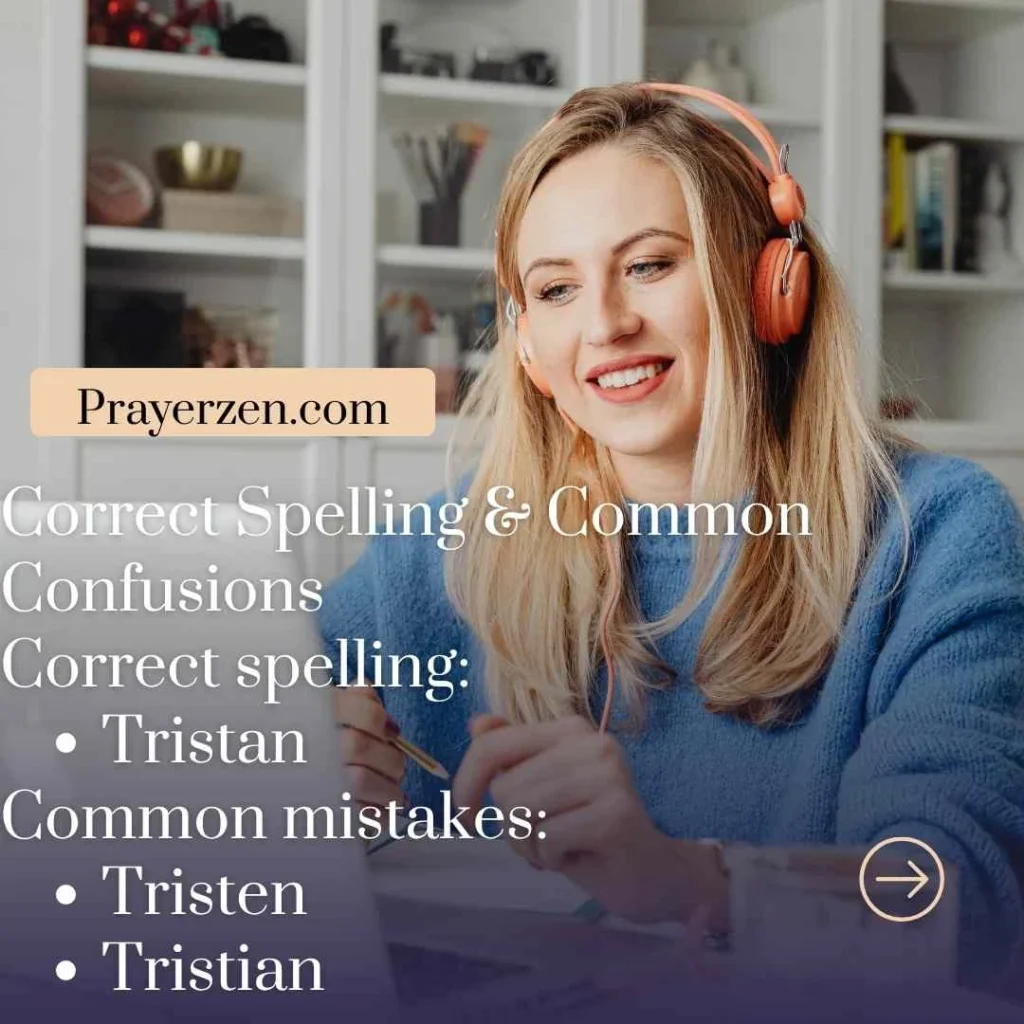
Correct spelling:
- Tristan
Common mistakes:
- Tristen
- Tristian
- Triston
- Tristann
Why these errors happen:
- Phonetic spelling influence
- Regional pronunciation differences
- Modern name variations for uniqueness
Mnemonic Devices (Memory Tricks)
To remember the meaning:
“Tristan = TRIs + STAN → A strong stand through trials.”
Or:
“Tristan tells a tragic story that stands the test of time.”
This helps connect:
- TRI = three emotional layers (strength, sadness, love)
- STAN = standing firm
Regional Variations (US vs UK vs Europe)
United States:
- Common masculine name
- Modern, stylish usage
- Often paired with surnames in pop culture
United Kingdom:
- Strong literary association
- Linked more closely to medieval legend
France:
- Strong historical connection via Tristan et Iseult
Germany & broader Europe:
- Used in classical literature contexts
Singular and Plural Forms
Names do not typically pluralize, but linguistically:
- Singular: Tristan
- Plural (rare usage): Tristans
Possessive form:
- Tristan’s story
- The Tristans’ group (multiple people named Tristan)
Grammar Rules & Linguistic Function
From a linguistic perspective:
- Type: Proper noun
- Category: Anthroponym (personal name)
- Function: Subject or object in sentences
Example:
- “Tristan is arriving today.” → subject
- “I met Tristan yesterday.” → object
Synonyms and Related Names
While names do not have strict synonyms, related names include:
Similar in style or origin:
- Tristanus
- Drustan
- Tristan (variants: Tristen, Triston)
Thematic equivalents:
- Lancelot (Arthurian romance)
- Galahad (heroic knight archetype)
Opposite conceptual names (symbolic contrast):
- Names meaning “joy” or “light”
- Example: Felix, Joy
Formal vs Informal Usage

Formal usage:
- “Mr. Tristan Williams attended the meeting.”
Informal usage:
- “Tristan’s coming over later.”
The name remains consistent across contexts, but tone changes.
Illustrative Examples
- Tristan is a name of Celtic origin.
- The meaning of Tristan is often linked to sorrow and bravery.
- Tristan appears in medieval French romance literature.
- Many parents choose Tristan for its strong sound.
- Tristan is commonly used in English-speaking countries.
- The story of Tristan and Iseult shaped its popularity.
- Tristan symbolizes emotional depth and loyalty.
- The name Tristan has evolved through multiple languages.
- Tristan is pronounced “TRIS-tan” in most regions.
- Tristan remains a timeless and classic name.
- The legend made Tristan famous across Europe.
- Tristan is still widely used in modern naming trends.
Practice Section (15 MCQs)
1. The name Tristan is mainly of:
A) Arabic origin
B) Celtic origin
C) Japanese origin
D) Sanskrit origin
2. Tristan is commonly associated with:
A) Wealth
B) Tragedy and romance
C) War only
D) Science
3. The pronunciation of Tristan is:
A) TREE-stan
B) TRIS-tan
C) TRAI-stan
D) TRES-ton
4. The literary legend associated with Tristan is:
A) Romeo and Juliet
B) Tristan and Iseult
C) Hercules
D) Beowulf
5. Tristan is a:
A) Verb
B) Adjective
C) Proper noun
D) Adverb
6. The Latin form of Tristan was:
A) Tristano
B) Tristanus
C) Tristium
D) Tristhan
7. The name is mostly:
A) Feminine
B) Masculine
C) Neutral only
D) Animal name
8. Tristan is associated with:
A) Air element
B) Emotional and romantic symbolism
C) Technology
D) Numbers
9. Common spelling mistake:
A) Tristaan
B) Tristian
C) Triztan
D) Trissstan
10. Tristan’s root meaning may relate to:
A) Silence
B) Tumult or noise
C) Light
D) Peace
11. Tristan is popular in:
A) Only Asia
B) Europe and English-speaking countries
C) Antarctica
D) Ancient Egypt only
12. Tristan is best classified as:
A) Common noun
B) Proper noun
C) Abstract noun
D) Verb
13. The name evolved through:
A) Only Greek language
B) Celtic, Latin, French influences
C) Arabic only
D) Modern slang only
14. Tristan symbolizes:
A) Emotional complexity
B) Only happiness
C) Machines
D) Geography
15. Tristan is used today as:
A) A city name
B) A personal name
C) A planet
D) A chemical term
Answer Key:
1-B, 2-B, 3-B, 4-B, 5-C, 6-B, 7-B, 8-B, 9-B, 10-B, 11-B, 12-B, 13-B, 14-A, 15-B
Frequently Asked Questions (FAQs)
1. What does the name Tristan literally mean?
It generally means bold, sorrowful, or tumultuous, depending on linguistic origin.
2. Is Tristan a biblical name?
No, Tristan is not biblical; it comes from Celtic and medieval European traditions.
3. Is Tristan a rare name?
It is moderately popular in Western countries but not overly common.
4. What personality is associated with Tristan?
Often described as emotional, loyal, and strong-willed (symbolically).
5. Is Tristan a good name for a baby?
Yes, it is widely considered a strong, classic, and timeless name.
Conclusion
The name Tristan is far more than a simple label it is a linguistic journey through Celtic roots, Latin adaptation, and medieval romance.
It carries meanings of strength, emotional depth, and tragic beauty.
Its popularity today reflects its timeless appeal across cultures.
Understanding its origin helps us appreciate how language evolves through storytelling.
Tristan remains a powerful example of how names preserve history in sound.
Whether used in literature or modern life, it continues to resonate deeply.
In essence, Tristan is a name shaped by emotion, history, and enduring human imagination.

Olivia Brooks
Hi, I’m Olivia Brooks, a passionate writer and believer in the power of words and prayers. Ever since I can remember, I’ve found comfort and inspiration in sharing thoughts that uplift the soul. Writing, for me, is not just a craft—it’s a way to connect hearts and bring hope to those who need it most. I love exploring the delicate balance between faith, life challenges, and finding peace in everyday moments. Through my stories, I hope to remind everyone that even in the darkest times, a little prayer can light the way. When I’m not writing, you’ll find me enjoying quiet mornings with a cup of tea and my journal.
Books by Olivia Brooks:
-
Whispers of the Soul
-
Light in the Shadows